By John Perkins
I spent time in Bandar Abbas on the Strait of Hormuz in the 1970s. My company, Chas. T. Main Inc. (MAIN), was hired by the Shah (at the Pentagon’s urging) to help develop a massive military base there that gave the Shah (and presumably the US) control over this strategic waterway. It turned out to be a terrible mistake. Today Bandar Abbas is the location of Iran’s First Naval Zone, major ports, and branches of the Islamic Revolutionary Guard Corps. The Iranians have used the military base we developed to shut down the strait. The below is excerpted from my book The Secret History of the American Empire (published in 2008 – slightly edited for context):
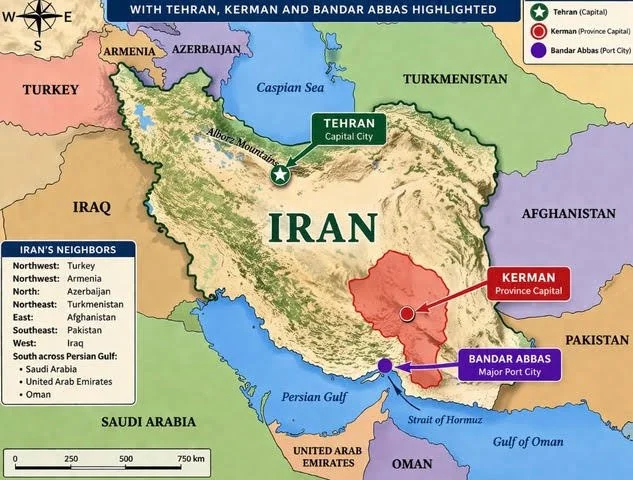
I joined two MAIN engineers, Frank and James, on a small plane from Tehran to the remote ancient oasis town of Kerman, the gateway to the Dasht-e Lut desert, which I was told was the hottest place on earth. It was midsummer; although late afternoon, the heat was stifling.
The town appeared neglected by time and, except for a few children and old people loitering in the shadows, vacant. Sweating profusely, we checked into the town’s best hotel. The lobby was small, gloomy, and practically devoid of furniture. The young man behind the receptionist counter was pleased to inform us that, yes, they served cold beer at their patio bar. Each of us had our own room– amazingly “with bathroom” – and we agreed to meet at the bar in 30 minutes.
My room was sparse, but delightfully clean. Although there was indeed a bathroom, I discovered that the toilet did not flush. Two faucets protruded next to it. The higher one turned on a tiny spigot above my head that I suppose served as a shower; the lower one could be used to fill a rusty bucket that allowed me to flush the toilet.
I stripped down to take a shower, standing in the tiny space between the toilet and the wall. There was no shower curtain; when I turned on the faucet, a poultry spray missed me but drenched the toilet. If I leaned over the porcelain bowl, I could dampen myself enough to work up a lather and rinse off. The only other indication that this contraption was supposed to perform the function of a shower was the hole in the floor at the opposite end of the bathroom through which the water eventually drained.
Feeling surprisingly refreshed after my shower, I made my way to the patio bar – four rust-flecked iron tables, and a dozen chairs situated on a terrace that opened to an impressive view of the nearby desert and the distant mountains. One of the engineers, Frank, was already seated there, three full beer glasses on the table in front of him.
“Only one brand,” he said. “I figured you’d take it.”
When James arrived, he shuffled across the terrace looking bedraggled. He was holding the shirt he had worn on the flight out. It was sopping, dripping, wet. He slapped the shirt onto the table, plopped down in the empty seat, and drained his glass of beer.
“What happened?” Frank asked.
“I had to take a crap,” James replied. “The toilet wouldn’t flush. I saw that damn bucket and turned on the faucet – the wrong one. I got soaked by the shower.”
When we finally stopped laughing, Frank pointed out that the desert air would dry the shirt in no time.
“That’s what I figured,” said James. “Otherwise, I’d never have carried it out here to this fancy bar.”
The next morning, we were picked up by two Iranians – a government engineer/translator and a driver in a jeep wagon. They took the front seat and the three of us crammed ourselves into the back seat, me – the youngest– in the middle, straddling the mound of the driveshaft.
As we drove along the crude road that would transport us from the high central plateau desert down to the shores of the Persian Gulf, the Iranian engineer explained that we were following the route of ancient caravans, part of the old Silk Road network. He pointed out that the Dasht-e Lut desert provided a direct connection between the Soviet Union and the Persian Gulf.
“You know that the Russians want to occupy us,” he said. “This very road we travel will become a superhighway for their military. Right alongside they’ll build a huge oil pipeline. The little town where we’ll sleep tonight, Bandar Abbas, will become a communist fortress. If we let that happen, they’ll control the world’s most important oil routes.”
“Guess that sums it up,” James observed. “We got quite a job ahead of us. Don’t feel pressured though, my friends. All we have to do is save the world from communism.”
The key,” the Iranian continued, “is for us – you Americans and us Persians – to do it first. We must build that military highway, and we must turn Bandar Abbas into our own fortress.”
The desert was not the endless waves of sand that Peter O’Toole had struggled through in Lawrence of Arabia. There was nothing monotonous about the mountains of red, purple, and russet that stretched for as far as the eye could see. To my mind, it was absolutely beautiful. And it was foreboding. I could not imagine caravans of hundreds of people and camels crossing it.
Despite the jeep’s AC, there was no relief from the oppressive heat. We made a number of stops so the engineers could test the soil and other conditions that would impact a high voltage electrical transmission line, oil pipeline, and military highway.
About halfway through the trip, the car filled with a terrible odor.
“Something’s burning!” Frank yelled.
The driver pulled to the side of the road and slammed on the brake.
“Everyone out,” the Iranian engineer, commanded.
The doors flew open and everyone leapt to the ground, except me. I could not lift my feet from the floor. My legs felt paralyzed.
“Hurry up,” James commanded. “What’s wrong with you?”
I had no idea. I strained with all my might, but my feet simply would not obey. Panicked, I slipped out of the loosely-tied topsider shoes I was wearing. Thankfully, my feet responded. I pushed myself through the door and tumbled onto the desert floor.
Cautiously, Frank peered back inside. Then he began to laugh. “The rubber souls of your shoes,” he turned to me, “melted and welded to the carpet over the driveshaft. I’ve seen engines overheat before, but this takes the cake!
It required work, but eventually, I was able to separate my topsiders from the burnt carpet and we continued on. We arrived in Bandar Abbas just as the sun was beginning to set.
Located on the Strait of Hormuz, opposite the horn of the Arabian Peninsula, where the United Arab Emirates, Oman, Bahrain, and Qatar were created when the British withdrew in 1971 Bandar Abbas commands one of the world’s most strategic corridors. It was once the headquarters of fierce pirates who marauded ships sailing out of the Arabian Sea. Today much of the world’s petroleum passes close to its shores.
When we arrived, Bandar Abbas was still a small, impoverished fishing village, with an enormous modern hotel located right on the strait – a prerequisite to attracting the type of consultants and contractors who could transform this town into a state-of-the-art military-industrial center. The five of us were some of the hotel’s first guests. We assembled for dinner to find that we and three waiters had the spacious restaurant to ourselves.
“Come back in five years,” the Iranian engineer said, “and you won’t recognize this place. One way or another, it’ll change. Either you’ll do it or the Russians will.”
(Pages 201-204)
That was fifty years ago. The US military has known ever since that whoever controls Bandar Abbas controls the Strait of Hormuz. I presume the Pentagon and CIA had shared that knowledge with Trump. It seems absurd that the US would blunder into this war without taking out Bandar Abbas. The initial US attacks may have killed Iran’s leadership, but Iran is still left with one of the most critical military bases in the world intact. It also seems absurd to consider leaving our European allies to face the consequences without us – given that the US started the war and our economy is vulnerable to global oil prices.
When I wrote about that episode in 2008, I knew that the Islamic Republic of Iran controlled the straits. But I never guessed that the United States would initiate military actions that would give their radical leadership an excuse to take control of this incredibly vital area of the world, disrupt the global economy, and cause dissention among US allies.